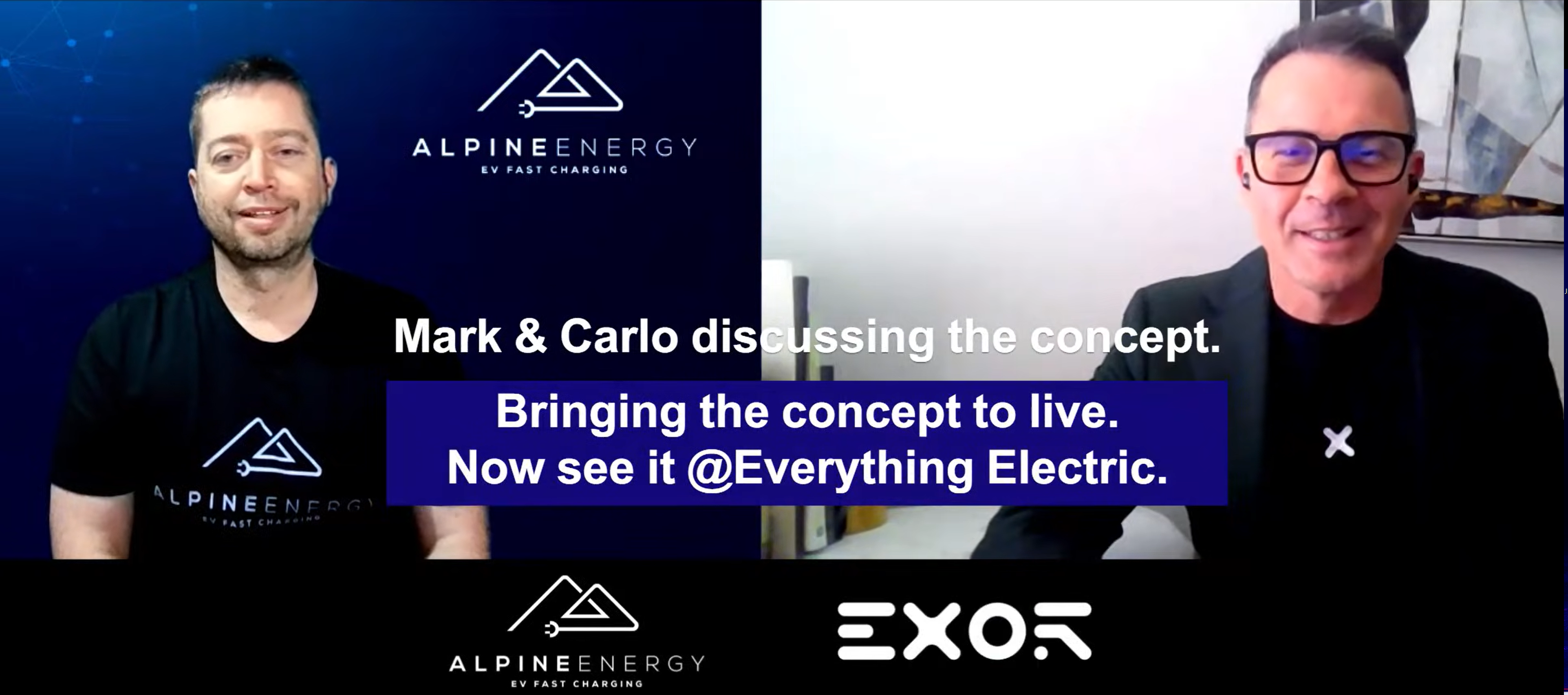
Mark sat down with Markus on the Your Energy Answers podcast to talk about what happens when an EV runs flat and why we think the answer is to bring the charger to the car. Markus asked the questions a lot of drivers are quietly asking: what does it cost, how long does it take and is this just a clever idea or something that will actually be on the road?
Here are the highlights.
Jumper leads for an EV
Mark opened with a simple story. You park at the airport, fly out for a family holiday and come back a week later to a flat battery. What do you do?
Today the answer is usually a tow truck to the nearest charger. With mobile vehicle-to-vehicle charging, someone drives to your car and charges it on the spot. As Mark put it, think of it as jumper leads for an EV.
Flat batteries happen for ordinary reasons:
- A strong headwind or a 110 km/h highway uses more energy than the dashboard predicted.
- The air conditioner is left running on a 40-degree day while the family stops for lunch.
- The only fast charger in town is out of order or already has a queue.
- A hire car is handed over with almost no charge left.
Mark has seen this first-hand. Running our stationary charger in regional Victoria, the team regularly drove hire cars with a 400 km quoted range to a site 220 km away and arrived with less than 10% left. On one long weekend, a nearby supercharger failed and seven EVs lined up at our small fast charger. In the city, chargers are everywhere. In the regions, one outage can leave people stuck.
How MGEN works
Markus assumed we carried a stack of batteries in the back of a ute. We don't. Mark explained that MGEN, our mobile DC fast charger, has no battery of its own. It draws energy from the donor vehicle's own battery and delivers it to the stranded EV through a fully compliant CCS2 charger.
That design choice matters:
- It's safe. The energy comes from a road-tested vehicle battery in a car with a five-star ANCAP rating, not loose batteries bouncing around in a tray.
- It's light. The MGEN unit weighs about 60 kg, compared with hundreds of kilos for battery-based systems. Less weight means less wear on tyres and brakes and less energy used.
- It keeps going. The Shark is a petrol-electric hybrid, so its generator can top up the battery while driving or while charging another car. With a larger fuel tank, we estimate one vehicle could help 20 or more EVs in a day.
- It moves with the fleet. MGEN is vehicle-agnostic. It can be retrofitted, and when an operator upgrades a vehicle, the charger moves across. The tray stays free for tools and equipment.
A 15-minute charge at 40 kW gives the average EV about 65 km of range. That's around 20 times faster than plugging one car into another car's power point, which runs at roughly 2 kW and takes hours. Mark's point was that time matters more than cost: we believe MGEN gets drivers moving up to five times faster than waiting for a tow.
The hardware and software are ours, with patents pending. We've built it with support from world-class partners, including EXOR for the rugged, cyber-secure onboard computer and Amphenol for EV charging componentry. The charger meets Australian and IEC standards and supports tap-and-go card payment.
Who it's for, and where it's heading
We won't be driving around Melbourne in uniforms rescuing motorists ourselves. Alpine Energy builds and sells the equipment and software. Roadside assistance and towing companies fit MGEN to their vehicles and give their EV members a faster way back on the road. We have signed letters of interest with roadside assist operators, and you'll see MGEN on the road soon.
The conversation also covered where else mobile charging makes sense:
- Grid resilience. After a storm or flood takes out the power, EV drivers who planned to charge overnight can be stuck at home. Utilities have asked us about MGEN as a generator on wheels, able to support a supermarket or service station as well as cars.
- Mining and remote sites, where the nearest charger may be hours away.
- Ports and dealerships. Some EVs arrive from overseas shipments or sit on a lot long enough to go flat. MGEN can charge them where they are.
- Export. Since launch we've had strong interest from the US, Singapore and the United Arab Emirates, where heat and rugged conditions are much like ours.
Looking further ahead, Mark sees mobile energy becoming a service, a bit like food delivery. Your car signals that it needs charge, and someone tops it up while you have lunch.
Mark also spoke about the road from engineering to business. Alpine started out bootstrapped, and the EnergyLab accelerator has been pivotal in turning a working prototype into a commercial product.
The full conversation runs just over an hour. It also covers pole-mounted batteries, why public chargers fail, tap-and-go payment and the future of Australia's grid. Watch it on YouTube.
Thanks again to Markus and Your Energy Media for giving Australian clean energy innovators a platform, and for asking the hard questions.
If you run a roadside assistance, towing, fleet, mining or utility operation and want to see MGEN in action, we'd love to hear from you. Get in touch with the Alpine Energy team.